


Consano Earth's Christmas 2025 Letter

2025 is the fourth full year for Consano Earth having been formalised in 2021. Our objective for this year, and every year going forward, is to add momentum to the fantastic work being done by our charity partners through rising financial and other support. Our efforts focus on smaller organisations where we believe our unrestricted funding can make a real difference and where we hope to be able to add value either ourselves or through our personal and professional contacts. Prior to 2024 we published a letter every Christmas that looks back on what we have been up to as well as some of the things we are looking forward to for the following year. However, in 2024 after a busy six months we published a mid-year review, and we have done the same this year. This Christmas Letter will therefore focus on our activities in the second half of the year and a look ahead to 2026.
Our two core charities remain Heal Rewilding and Project Seagrass but this year we have added Conservation Without Borders and The Thousand Year Trust to the organisations we support. We also stepped up our funding for Citizen Zoo given the continued fantastic work of Elliot Newton and his team. We have supported them on various initiatives in the last few years notably on the Ealing Beaver Project but have transitioned to our preferred ongoing and unrestricted basis funding model. This page provides details of all our charities as well as links to their websites for those wanting to learn more. Any support you can give, however small, monetary or otherwise, is hugely appreciated by these wonderful charities.
Enjoying the summer months at Clapham Common Wetlands
In last year’s Christmas Letter we discussed a wonderful rewilding project very close to home. In 2024 we were excited to learn about an ambitious project that Friends of Clapham Common were pursuing in partnership with another local charity Wild Clapham. This was to transform a subterranean hollow measuring approximately 40 metres by 25 metres into a wonderful wetland for amphibians with the banks planted with species of flora to provide foliage food for butterflies and moths. We are proud to be one of the major funders and partners of this fantastic project.
In our Summer Letter we documented the construction journey of the wetlands with the site open to the public since May. It will take some time for the wetlands to mature but we were delighted over the summer months to see an abundance of dragonflies and many other creatures at the site.

Given its proximity to where we live, we regularly walk through the wetlands which changes every time we see it. It is wonderful when we see parents with their young children stopping on the bridge to spot the increasing amount of wildlife. Having access even to what is a modestly sized site is very important in urban areas especially when it comes to engaging children’s interest in nature and the environment.
A Visit to the Ealing Beaver Project
When people ask us what we do at Consano Earth the project we most often use as a case study is the Ealing Beaver Project, London’s first fully accessible urban beaver reintroduction site. The project is led by Citizen Zoo and Ealing Wildlife Group.
We visited the site in September hosted by our friend Sean McCormack from Ealing Wildlife Group and Beaver Trust, one of our charity partners. Thankfully the beavers came out to say hello although our photography leaves a lot to be desired!

Consano Earth funded the signage at the site and the making of a film “Beavers in Paradise” that documents the project’s journey showcasing the early impact these wonderful ecosystem engineers are having on the site. If you haven’t watched the film yet it is available to see here. Even better is go and see the site for yourself. Fantastic, guided walks are available.
We continue to be thrilled with the traction “Beavers in Paradise” has had and are proud to say it has won a prestigious award. The Wildlife Conservation Film Festival (WCFF) awarded the film the Gabriel Figueroa Special Award at its 2024 festival with the judge noting:
“Beavers in Paradise stood out as being uplifting and a film that was a genuine pleasure to watch”
“One striking thing was that you identified a problem, found a low tech, doable and relatively easy solution, and accomplished it.”
“Overall, the team’s cheerfulness and enthusiasm came across and it was easy for the viewer to feel this and get excited about the project.
“It doesn’t seem to be widely appreciated that beavers have any place in inner cities.”
“Sadiq Khan’s enthusiasm and support was a great idea to include. It carried a significant weight and I found his input stylish and helpful”

Visiting the Bison bridges at Wilder Blean with Kent Wildlife Trust
On a wet day in September we were very lucky to be hosted by the team at Kent Wildlife Trust on a visit to the Wilder Blean Project which they lead in partnership with our friends at Wildwood Trust. Many thanks to Evan Bowen-Jones, Paul Hadaway and Sarah Jordan for showing us around.
The project is a first for UK conservation: introducing European bison as natural woodland management in West Blean & Thornden Woods, near Canterbury in East Kent.
The bison area at Wilder Blean will eventually encompass 250 of the 400ha site. The bison took up residence in 2022 initially in a 50ha area. In 2025 two bison bridges were opened giving the free-roaming herd, now 8 strong, an additional 38ha. The team are currently fundraising for the final two bridges. The target is to get them installed in Spring 2026 which will connect the final areas giving a total of 250ha as shown below.

We visited both bison bridges and were also lucky enough that when we got to the holding area the bison herd were there to say hello including a recently born calf.

Kent Wildlife Trust is deliberately pushing the boundaries of UK conservation through the Wilder Blean project. This is already catalysing positive change by acting as a benchmark demonstration project for urgent nature and climate action. They have reached hundreds of millions of people globally, and hundreds of key decisionmakers from across the UK already.

By installing the final two bison bridges, the team can expand the herd’s range, maximise the ecological benefits, and prove that outdated restrictions like Dangerous Wild Animal (DWA) licensing are unnecessary. This will not only reduce costs for future projects but also provide a scalable model for restoring bison as a keystone species across the UK for projects in development with Forestry England, Natural England itself, on MOD land, and on private estates.
Visiting Wild Tolworth with Citizen Zoo
Over the years we have supported Citizen Zoo on several initiatives including the Ealing Beaver Project and sponsoring their Rewilding Futures conference in January that we discussed in our Summer 2025 letter. We were delighted to be invited to visit their flagship project, Wild Tolworth, in October hosted by our friend and the always inspiring Elliot Newton. The project is less than 20 minutes by train from Clapham Junction so is very accessible to Londoners as well as the local community. As you exit Tolworth station you are greeted by their fabulous mural.

This pioneering 43-hectare project was started 5 years and is a collaboration between Citizen Zoo, The Community Brain and Kingston Council. They have a shared vision to establish a dynamic, mixed-mosaic nature reserve that nurtures a more diverse and abundant wildlife population. Through innovative rewilding measures inspired by rural projects such as mixed grazing regimes, the team led by Citizen Zoo aim to restore and enhance the ecological balance of the site’s seven meadows while honouring its rich cultural heritage.
This project has taken some significant steps forward this year most notably the restoration of a large wetland area in the Great Meadow. By restoring this important feature, they are providing vital new habitats for local wildlife while also reconnecting the site with its historical roots.
This will increase the presence of many bird species and amphibians on site. Additionally, by storing surface runoff and slowing water entering the river, the wetland will help to prevent flooding downstream.

The other exciting development this year will be the impending reintroduction of cattle to the site. After putting up 2.7km of secure livestock fencing several Sussex Cattle will be arriving in early 2026. These big, docile, hardy animals can be left out all year round. They will be joined in the not too distant by pigs and all their wonderful disturbance so important for creating a diversity of habitats. The map below is an excellent illustration of the team’s vision for the site.

Since our visit we have stepped up our support for Citizen Zoo to help them continue with their important work. The Wild Tolworth site is a fantastic example of how previously neglected council owned land can be transformed by a hard-working team at relatively small cost into an urban nature reserve that, where possible, embraces natural processes to drive a complex, dynamic landscape full of wildlife, while providing engagement opportunities for local people. We hope that Wild Tolworth can provide an inspirational template for others to follow in the London area and beyond.
With so much happening in the world of rewilding we often struggle to keep up with all the exciting news especially from overseas. We were therefore delighted when Citizen Zoo launched a new podcast this summer in which the team discuss some of their favourite stories from the frontlines of rewilding from around the globe. You can find more information here. It’s well worth subscribing to.
Our work with Keep It Wild and their Species Recovery Centre
One of our key charity partners since we founded Consano Earth has been Keep It Wild, the CIC led by Derek Gow and Nick Viney. We have worked with them notably on the building of additional wildcat breeding facilities at Rewilding Coombeshead, the 400 acres of wild Devon owned by Derek, as well as helping them fund the purchase of Panson Middle Bridge, a 26 acre wet meadow that is just up the road.
Each July the Keep It Wild team host a species reintroduction and rewilding symposium held over three days. Attendees are treated to numerous fascinating and inspirational talks mixed in with seeing old friends and making some new ones. As we discussed in our Christmas 2024 letter the most inspirational talk of the 2024 weekend came from 21-year-old Oliver Crowther, founder of OC Aviary. His topic was the Twite Conservation Project that was formed in 2023 with partners Derek Gow and Keep It Wild.
To be honest when we saw a talk on Twites on the agenda, we were not sure what to expect but we were treated to a presentation by a young man whose passion and dedication to his work was clear for all to see. We have yet to find anyone as passionate about birds as Oliver.
We increased our funding for Keep It Wild in 2025 which included some direct support for the Species Recovery Centre work Oliver is doing with them notably on Twites and Red Backed Shrikes. Some of our funding has gone towards a new block of Twite aviaries that were used for breeding this season pictured here.

Here is an update from Oliver discussing some of his highlights from this year:
“2025 began with the completion of a new block of breeding aviaries for our Twites. This has allowed the breeding population to double in size for the upcoming spring, giving us the capacity to produce a larger volume of chicks whilst aiding in my husbandry expertise for the species. Despite a challenging year due to unfavourable weather, the breeding season was successful which continued to increase our Twite population in year 2 of the project. Additionally having a larger population allowed me to conduct some behavioural research for my degree, studying the effects that adult sex ratios have on their pair-bonding behaviour and subsequent breeding implications. This has influenced the stock management side of the project, ensuring birds are housed with the high welfare standards in mind and to provide the highest likelihood of breeding success.”
This summer Oliver completed his four-year Master’s Degree in Bioveterinary Science at The University of Nottingham. He has always wanted a career as an avian conservation specialist, not the easiest career to get into as a young graduate. However, we were delighted to learn recently that Oliver has achieved his ambition joining the team River Horse Wildlife Conservancy, working alongside Toledo Zoo & Aquarium based in Ohio, USA. Oliver will continue to be based in the UK but will be supporting them with their avian conservation work all over the world including upcoming trips to Brazil and Vietnam. You might ask, as we did, how does a young UK based graduate get a job with an American zoo? A few years ago, Oliver started OC Aviary’s YouTube Channel which now has well over 400 videos and incredibly 35.3k subscribers.

Around a year ago Oliver published a documentary on Twites. The CEO of Toledo Zoo & Aquarium saw the video and reached out. Some of their team visited Oliver’s facilities in August this year and a couple of weeks later Oliver got a formal job offer.
We find Oliver’s story truly inspirational and what can be achieved by a young person who has relentless dedication to following his passion. Being able to support someone like him so early in his career is one of the most rewarding things we can do with Consano Earth. Oliver is making a real difference to the world, and it is wonderful we can give him a small helping hand as he continues his journey. The great news is that Oliver will continue with his important work with Keep It Wild and we will be helping fund this for the foreseeable future.
A day with Knepp Wildland Foundation
Anyone who has even the remotest interest in rewilding has undoubtedly discovered the wonders of the Knepp Estate which has been on a 20+ year trailblazing journey led by owners and rewilding royalty Charlie Burrell and Isabella Tree. Less well known is the charity Knepp Wildland Foundation (“KWF”) established by the team whose ambition is to catalyse nature recovery across Sussex and beyond. Led by the irrepressible Libby Drew there are now 18 people working on four key strategic areas.

Consano Earth was one of the charity’s very first donors in 2022 and we have maintained ongoing support ever since. In October we attended a Supporter Day held at Knepp.
Part of the event was a 2.5 hour walking safari led by two of KWF’s Young Guides. KWF provides paid training opportunities for 18–25-year-old, helping young people gain the skills and experience they need to launch their careers. Both our Young Guides were very well informed. We were delighted to be joined by Charlie Burrell for our stroll who added a few stories along the way too as only he can.
Importantly the event was a good opportunity to get an update on all KWF’s key initiatives. These are well documented on the KWF website but two closest to our hearts are Weald to Waves and the White Stork Project.

Working in partnership, KWF’s co-ordinates the landowner-led Weald to Waves (“W2W”) initiative where the ambition is to establish a 100-mile nature recovery corridor across Sussex, connecting fragmented landscapes to boost biodiversity, capture carbon, enhance food production, and enrich the rural economy.
W2W is a network of farmers, land managers, councils, researchers, wildlife charities, schools, gardeners and community groups that collectively have pledged to date c.22,000 hectares of land. There are c.77,000 hectares overall in the corridor so W2W has made some fantastic progress and the team are relentless in getting this penetration even higher. Consano Earth provided much of the funding for the mapping technology platform that underpins the project (have a play with the interactive maps here).
We believe W2W provides a fantastic exemplar of what can be achieved when communities come together and knit together all-important nature corridors. This is not just necessarily about landowners pledging large parts of their land to nature (although that is always nice!) but also about much smaller initiatives like having suitable hedgerows in place.

We are starting to see similar networks to W2W emerge, for example Tor to Shore in Cornwall. The team at KWF would love to see these networks all over the UK and have always been very keen to share some of their lessons and best practice. With that in mind KWF is at the early stages of forming Wilder Ways — a national alliance of nature recovery corridors — and we’re excited to see how this collaborative network evolves.
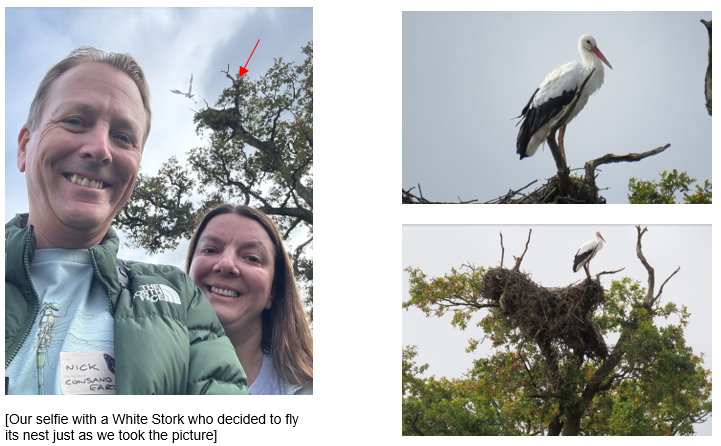
The White Stork Project at Knepp has been truly amazing since the first wild chicks in 2020. 2023 saw the first ground nest build with the first breeding migratory return the following year. 2025 had 3 breeding migratory return and 45 chicks fledged from 18 nests. This year Knepp and Storrington became the 16th member of the European Stork Villages Network. Since 1994 the EuroNatur foundation has honoured 16 villages in 16 European countries for their engagement in white stork and nature conservation with the title “European Stork Village”.
It would be simply wonderful to see more of these iconic birds in both our rural and urban landscapes. This year Citizen Zoo, helped by some funding from Rewilding Britain, launched the London White Stork Project that is looking into the feasibility of White Storks coming to the capital.
New Lynx Enclosure and Breeding Facility at Wildwood Kent
In October we sponsored the opening event of the new Lynx enclosure at Wildwood Kent. Wildwood is a native species conservation charity established in 2002 to push the boundaries of innovative conservation and rewilding. They work with nature to fight the biodiversity crisis, to halt the extinction of species and to create resilient habitats in which nature thrives. Wildwood focus on evidence-based solutions to return native species and recreating truly wild spaces. The team believe that rewilding, through the reintroduction of keystone species, is the most powerful tool we have.
Keystone species change the landscape by creating the space and complexity for hundreds of other species to recover and thrive. Wildwood’s experience and expertise in working with native species means they can work effectively across the UK in many projects.
We have supported Wildwood for several years. Led by the ever-passionate Paul Whitfield (pictured with us at the event) they continue to do important breeding and reintroduction work on many species including Lynx, Wildcats, Pine Martens, Red-billed Choughs and Crayfish. They are also a key partner on the Blean Bison Project which is situated next door to Wildwood Kent.

The new Lynx enclosure is 5x the size of what Wildwood had before and totals an impressive 3,500 square metres. Currently, there are a pair of Lynx in the enclosure, a brother and sister. Wildwood’s ambition is to breed Lynx in the future and therefore this has been incorporated into the design.
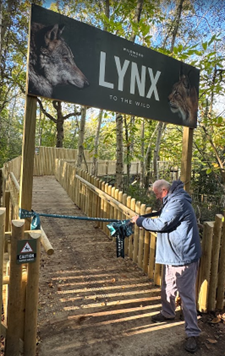
However just as important as being a future breeding facility is the enclosure creates an exciting habitat that showcases the Lynx to the public. Pictured here is Sir Roger Gale cutting the ribbon at the entrance to the new viewing bridge that overlooks both the Lynx and Grey Wolves enclosures giving visitors an even better opportunity to see these wonderful animals. Sir Roger is the Conservative Member of Parliament for Herne Bay and Sandwich. He has been a long-term supporter of Wildwood’s work and is also a strong advocate for the reintroduction of beavers in the UK, serving as a "species champion" for the animal.
As part of their Lynx work Wildwood have been supporting The Missing Lynx Project who are investigating the possibility of reintroducing Lynx to Britain. The Project is led by Northumberland Wildlife Trust, The Lifescape Project and The Wildlife Trusts.
Lynx were most likely lost from the UK during the late medieval period (about 1050 to 1500). They were driven to local extinction by hunting and habitat loss (with similar issues affecting Europe). The Project’s first step was to explore whether Lynx could live in the UK. To do this, The Lifescape Project used a similar approach to that used in Germany, where Lynx have already been successfully brought back. They worked with European experts to test ‘ecological feasibility’ - in other words, they tested whether there would be more than a 95% chance of Lynx surviving and growing to healthy populations in Britain.
Their research found that if Lynx were to be released in Northumberland, they could grow into a healthy population covering north-west Northumberland, the edge of Cumbria and the bordering areas of southern Scotland.
A year-long social consultation then followed which found that 72% of people in the project area, supported potential Lynx reintroduction. These results coincided with the publication of a new peer-reviewed paper that showed that a release of 20 Lynx over several years into the Kielder Forest area would, over time, create a healthy population of about 50 animals. We look forward to hearing about further progress as the Project continues to work hard on the exciting possibility of Lynx reintroduction in Britain.

What follows are a few pictures of the enclosure but there is nothing like seeing these fabulous animals in person. If you are in the Canterbury area in Kent, Wildwood in well worth a visit. Here is the inner area where the Lynx have an abundance of platforms (and a hammock!)….

The viewing bridge where visitors can look down and see right into the inner areas as well as the surrounding paddock….

A Lynx exploring the paddock area for the first time….

Celebrating 10 years of Rewilding Britain
In late November we were delighted to sponsor Rewilding Britain’s “10 Years of Wild Hope” evening which marked the ten-year anniversary of the formation of this wonderful charity.
Rewilding Britain has played a critical role in moving rewilding from a niche idea into the mainstream. What they have been able to do in the last decade is inspirational.
Some of their achievements include a 1,000 strong Rewilding Network that is transforming habitats and livelihoods at land (over 200ha) and sea (over 1,000km²). In 2022 their rewilding garden featuring a beaver inspired landscape, complete with a dam made of beaver-gnawed sticks, caused quite a stir when it won Best in Show at the RHS Chelsea Flower Show. You can read about their 10 biggest impacts so far here.
The event was superbly hosted by the comedian, Nish Kumar, who led us through an action-packed event which included some fabulous talks from Rewilding Britain CEO Rebecca Wrigley and George Monbiot and music (and singalong) with Karine Polwart and Sam Lee. One highlight was seeing the chemistry between Nish and George, pictured here, tag-teaming as auctioneers for the “wild auction”.

Another highlight was our friend and rewilding legend Charlie Burrell first recalling some of his early challenges in establishing Knepp before looking to the future with the help of two of the most inspiring young voices in rewilding today.

Lira Valencia, the former wildlife ranger, is using social media to bridge the gap between urban communities and nature (join her 100k+ followers here). Growing up she had to suppress her love of nature amongst her friends. Today she is using her platform to get more urban and especially young people into nature talking to them in a way they can understand and relate to.
Jack Durant is co-founder and co-director of Youngwilders. Youngwilders is a young-led charity working to accelerate the nature recovery in the UK and to centre young people in the process and movement.
We know Jack and the Youngwilders team well having started supporting them in 2023. We got to know Youngwilders through our friends at Knepp Wildland Foundation. Youngwilders host the UK’s only youth rewilding summit, “Overgrowth”. Overgrowth is made of up three key aspects, two yearly events and an online series bridging the gaps between. Overgrowth South is hosted at Knepp with Overgrowth North taking place at Hepple Wilds in Northumberland. Two hundred young people attend each year.
Core to Youngwilders is their lead nature recovering projects across the country where they work with young people to design and implement long-term management principles across their sites letting nature lead the way as much as possible. They are up to 12 projects already with over 200 acres in recovery and had over 400 people engaging with these in the last year.
Another key aspect of their work is their nature education programs. This year the team introduced a brand-new programme, Wayfinders, offering young people the opportunity to gain hands-on ecological field ID skills at their nature recovery project sites across the UK. The Wayfinders programme supports employability and skills related to nature by providing financially accessible ecological surveying training in which participants will learn and actively deliver various ecological surveys, covering grassland, bats, birds, woodland health, soil, and invertebrates. They engaged 58 young people during this pilot year and worked with them in shaping the future design of the programme.
Also, this year Youngwilders launched their Wild Stewards programme which places young people into paid, key decision-making roles in active nature recovery projects for one year, providing them with seminar and training opportunities as well as mentoring from the Youngwilders team, and peer support from other Wild Stewards across the country.
It was fantastic to see Youngwilders’ fantastic work recognised in November in The Guardian. Not only was there a feature length article but the team also made the front cover of the print edition. The recognition is very well deserved, and we look forward to continuing to help Youngwilders in the years ahead.

Rewilding Britain is looking forward to its second decade with excitement and optimism. Today, 83% of the British public support rewilding, according to their most recent polling.
The team believe we’re only just beginning to tap into rewilding’s full potential, but their mission is to see it flourish across at least 30% of Britain’s land and seas by 2030. We completely share this vision. When nature thrives everything else follows.
Looking ahead to 2026
We expect 2026 will be another year of good progress for the charities and work we support. What follows are just a handful of what we hope to see over the coming year.
Our core rewilding charity for the land is Heal Rewilding. Jan Stannard, Heal founder and CEO, had the following to say as we move closer to 2026:
This year has been a very different one at Heal’s 460-acre rewilding site in Somerset, as the team began accelerating the site’s recovery through two key projects and major interventions aimed at restoring fully functioning ecosystems.
The first project focused on woodland regeneration. During the year, an area of nearly 200 acres was enclosed by a 4km long, 1.8m high deer fence. This fence will prevent over-browsing by deer of regenerating tree saplings and scrub. It also enabled the release of the resident Tamworth pigs – proxies for wild boar – from their electric-fenced enclosure, so that they are wild living and free roaming, a very exciting development. The pigs will positively impact the area through their foraging and soil disturbance and are already having a major impact through their rootling actions.

The second project has involved renaturalising water across the site. So far, 20 leaky dams have been built in half a kilometre of watercourse, 40 bunds (earth banks) with scrapes (shallow pools) created to provide over 1,000m2 of new water storage, and a 300m length of ditch infilled, resulting in half a hectare of new wetland. All of this work will result in new habitats for a wide range of species, as well as being natural flood management features. More major engineering works have been carried out by the wild-living beavers on the site, who have now built ten dams on one of the tributaries of the River Frome and created the first beaver wetland. They have also had three kits!

Wildlife has been noticeably more abundant. The 2025 highlights include the list of recorded bird species rising to 93 (from 67 in 2023), 17 bat species confirmed as using the site, and several more butterfly species being recorded, with 27 now on the list (up from 11 in 2023).
The programme of partnerships with 15 local organisations resulted in hundreds of people from underserved communities coming to Heal Somerset in 2025 to experience the benefits of nature, and three local education partnerships have provided opportunities for youth volunteering and work experience. Over 4,500 volunteering hours were logged.
In 2026, the first positive impacts from the wetlands work will be seen at Heal Somerset and Heal expects a rise in visitor numbers. The charity will publish its first State of Heal Somerset Nature report, sponsored by Consano Earth. This report, inspired by the national State of Nature report, aims to provide a contrasting perspective on the state of nature at a rewilding site, showing gains and positive outcomes.
Our core rewilding charity for the sea is Project Seagrass. Leanne Cullen-Unsworth, Project Seagrass CEO and Co-Founder provided this update for us:
Project Seagrass has continued to accelerate our mission to protect and restore the world’s seagrass through community, research, and action. In 2025 we deepened our partnerships across the UK and internationally, supporting the application of evidence-based restoration at scale while empowering communities, governments, and practitioners to deliver effective seagrass solutions.
Through our science-led approach, we have strengthened our role in global seagrass policy, expanded capacity-building initiatives, and continued to demonstrate the value of standardised methodologies that promote resilience, net gain, and informed restoration.
2025 Highlights
Launch of the Global Seagrass Challenge Fund, supporting coordinated research and community-led action worldwide
Strategic input into the development of the UN 2030 Seagrass Breakthrough, advancing global policy for seagrass protection
Coordination of Seagrass Network Cymru, supporting the creation of a National Seagrass Action Plan for Wales
Expanded restoration work across the UK, scaling efforts to enable recovery at ecosystem level
Significant growth in the Project Seagrass nursery, driving innovation to produce scalable, science-based planting methodologies
Thousands more data contributions to Seagrass Spotter, strengthening a global evidence base for conservation
Spotter had it’s 10th birthday and we reached a 10,000 sightings milestone to celebrate!
Launch of Seagrass Restorer!
Looking Ahead
The momentum continues into 2026 as we:
Grow our international collaborative networks to accelerate research, policy influence, and restoration capacity
Advance large-scale UK restoration through science, technology, and community empowerment
Continue to strengthen evidence-based tools and methodologies to support global seagrass recovery
Deliver and share new scientific outputs and best practice guidance through international partnerships
2026 takes the crown from 2025 as the most important year in the climate emergency just as 2025 took it from 2024. The time for action is now, and everyone can make difference. For anyone looking for an inspiring stocking filler here are some of our favourite books we have read in the last year:

For those of you with younger rewilders in the family we highly recommend the children’s book “Beaver Believers” written by our good friend Sean McCormack of Ealing Wildlife Group.
We hope to be much more active on social media going forward so please follow us on X and Instagram. We also plan to do some more regular updates in 2026. If you want to receive these please sign up on from our homepage.
We wish you all the very best for 2026.
Nick & Elena Martin
Consano Earth Co-Founders
December 2025


